Pages

Thursday, February 27, 2014

A Homeschool Co-op Lesson On Nutrition


A few years ago I was in charge of teaching an anatomy class for children ages 5-9 at our homeschool co-op. One of the topics we covered was nutrition. After searching for several months for some type of curriculum to use, I finally ended up doing some research and writing something myself. While I am not a nutrition expert, It is my hope that someone might still find something helpful here.


Drink Enough Water

Our bodies are mostly water, so drinking plenty of water is important if we want to keep our bodies healthy. Some symptoms of not drinking enough are fatigue, dry skin, headaches, and constipation. Over a long period of time, a shortage of water will cause your body functions to stop working properly. Drinking enough water will keep you healthier and may allow you to live longer.

What is enough water? You've may have heard that you should drink at least eight 8-ounce glasses of water per day, but a better rule to remember is to drink one quart for every 50 pounds of body weight. So, if you weigh 100 pounds, you need to drink two quarts, if you weigh 150 pounds, you need to drink three quarts, and so on.

You also want to make sure that the water you are drinking is good water. Most tap water should be avoided because it may contain chlorine and fluoride, toxic substances that are bad for your body. Distilled water should also be avoided because it can drain your body of necessary minerals. It is best to drink water at room temperature because ice-cold water can harm the lining of your stomach.

Can you give me some reasons why it is important to drink enough water?


Eat Lots of Fruits and Veggies

The National Cancer Institute and the Food Guide Pyramid recommend five to nine servings of fruits and vegetables per day to protect against cancer and other diseases. A serving of vegetables means 1/2 cup of cooked vegetables or 1 cup of raw salad vegetables. A serving of fruit is one medium piece, like apple or an orange.

You should eat fruits and vegetables at every meal. Make veggies the main course. Plan your meals around a "main" vegetable, instead of a meat or starch. When you fill your plate, vegetables should take up half the plate, with meat and starches filling smaller areas. And try to plan at least one vegetarian meal a week. But don't replace the meat with pasta and rice, instead use beans and whole grains.

Try something new. There are lots of different fruits and vegetables. If you try something and don't like it, move on to something different until you find a few you like. Or, try a different way of preparing the same old vegetables. If you don't like cooked peas, try them raw. If you don't like steamed zucchini, maybe you will like it grilled.

Use color to "please the eye and inspire the appetite". The most nutritious fruits and vegetables are the ones with the brightest and deepest colors, so paint your plate with color.

Choose fresh fruits and vegetables whenever possible. Because food looses vitamins and deteriorates in quality as it sits on store shelves, your produce will be more nutritious (and better tasting) if you grow it yourself or buy it locally. Eat vegetables that are in season. If something is not currently being harvested in your area, you know that it was either grown and shipped in from somewhere else, or it has been in storage. Either way, it isn't going to be fresh.

If you can't get something fresh, then buy frozen. Food that has been harvested and frozen quickly actually has more vitamins than most of the foods you will find in the produce section of the grocery store.

Veggie ABC's for younger children

What are some things to remember that will help you to start eating more fruits and vegetables?

Eat Natural

Eat as few over-processed and over-cooked foods as possible. Once food is cut or processed, it begins to lose its nutritional value. The heat of cooking also depletes vitamins, damages proteins and fats, and destroys enzymes. The closer your foods are to their whole, natural state, the more vitamins, minerals, and fiber they will have, and the better they will be for you.

Eat as many raw foods as possible. Most raw foods contain enzymes which help us to digest our foods. Once enzymes are exposed to heat, they are no longer able to do what they were designed to do. When the natural enzymes in food are destroyed, our body must make its own enzymes to process the food. Eating enzyme-dead foods places an extra burden on your pancreas and other organs, causing them to wear out faster. Lack of digestive enzymes can also be a factor in food allergies. Symptoms of digestive enzymes depletion are bloating, belching, gas, bowel disorders, abdominal cramping, heartburn and food allergies. If you do cook your food, the best way is to lightly steam, stew, or use a slow cooker.

Can you give me some examples of whole, unprocessed foods?

Know What's In Your Food

Another problem with processed foods is that they don't taste or look as good as whole foods. Your body will have a very hard time digesting over-processed and over-cooked foods because of all the sugar, salt, fat, and chemicals which are added to them to improve their quality. These kinds of foods are usually found in boxes, bags, cans, or jars.

The worst offenders are those foods which have been refined (such as white flour and white rice), pasteurized (things that have been flash-heated to high temperatures to kill bacteria), homogenized (a process which is used to keep milk and other foods from separating), or preserved (chemicals are added to keep the food from going bad or to improve the texture or taste). Make sure to read the labels of any canned foods that you do purchase. Even things like tomato sauce, beef broth, or vegetable soup may have added sugar or other unhealthy ingredients. Also, if you don't recognize what is in the food you're eating, it probably isn't very good for you.

What are some over-processed foods that you should avoid?


A Homeschool Co-op Lesson On Muscles

A few years ago I was in charge of teaching an anatomy class for children ages 5-9 at our homeschool co-op. One of the topics we covered was muscles. Since most of the children in the class are boys, I thought this was a good opportunity to keep things active and burn off some energy while we went over our lesson. Below is the lesson written out as I gave it.

Did everyone bring their muscles today? Let me see them! Good job! Did you know that you have over 640 muscles in your bodies? They help you run, jump, and play, but they also do things like pump blood throughout your body and help you digest your food. You control some of your muscles, while others - like your heart - do their jobs all by themselves. Try telling your stomach to digest your food. Can you do that? No, it just does it on its own, right? Muscles are made up of cells called muscle fibers. These cells form a type of elastic tissue- sort of like a rubber band. Thousands of small fibers make up each muscle and, when you exercise, these muscle fibers grow. So even though everyone has the same amount of muscles, some people will have bigger muscles. Although exercise helps your muscles to become bigger and stronger, too much exercize can cause your muscles to get tired and start to slow down. Sometimes overworked muscles can suddenly tighten up and become painful. This is called a cramp. When your muscles get tired, they need time to rest so they can get more oxygen and food,and can get rid of wastes.


Let's Experiment! Hold your right arm straight out in front of you. Count how many times you can open and close your fist in thirty seconds. Now rest for fifteen seconds. Try it again. Open and close your fist as many times as you can in thirty seconds. How many times were you able to do it each time? The second number should be smaller because your muscles were tired out. Now, hold your arms straight up over your head. I want you to keep them there while I continue the lesson. Keep them there as long as you can, and we'll see who can keep them up the longest.

Maybe you've heard a story from the Bible where Moses was told to do what you are doing right now. The Israelites were fighting an important battle and God told Moses to stand on a hill above the battle and hold his hands up like this. As long as his hands stayed up, the Israelites would be winning. But if his hands came down, the enemy would start to win. Eventually Moses' muscles got tired and a couple of his friends had to use their muscles to help him. If you haven't ever heard that story, ask your mom or dad to read it to you tonight.


Three Types of Muscles

You have three different types of muscles in your body. Can anyone name them for me? Raise you hand if you know . . . Just kidding! There are three types of muscles in our body: smooth muscles, cardiac muscles, and skeletal muscles.

Smooth Muscles Smooth muscles usually form smooth layers, with one layer of muscle behind the other. Smooth muscles are sometimes called involuntary muscles because you can't control them. Your brain and body tell these muscles what to do without you even thinking about it. Smooth muscles are at work all over your body. In your stomach and intestines, they contract and relax to digest food and move it through the body. In your bladder, they allow you to hold in urine until you can get to the bathroom and they help you to push it out. Smooth muscles are also at work in your eyes, keeping them focused and causing you to blink.


Let's Experiment! OK, you're going to have to put your hands down now. Hold them in front of your face and hold the tips of your pointer fingers out so they are close but not touching. Try to keep your fingers perfectly still without moving them at all. Now, stare at your fingers and try not to blink. What happens? Does it look like your fingers are bouncing around? That is because the involuntary muscles in your eyes are trying to blink. Eye muscles are the busiest muscles in the body. Scientists estimate they may move more than 100,000 times a day!

Cardiac Muscle The kind of muscle that makes up your heart is called cardiac muscle. The thick muscles of the heart contract to pump blood out and then relax to let blood back in after it has circulated through the body. Just like smooth muscle, cardiac muscle works all by itself. You don't have to tell your heart to beat. It works even when you aren't thinking about it.


Skeletal Muscle Skeletal Muscles are the kind of muscle you think of when we say "muscle" - the ones that you all showed me when I asked you earlier. Skeletal muscles are voluntary muscles, which means you can control what they do. The skeletal muscles work with your bones to allow you to move. Most skeletal muscles are attached to one end of a bone. They stretch all the way across a joint (the place where two bones meet) and then attach again to another bone. Skeletal muscles are held to the bones by tendons. Tendons are cords made of tough tissue that connect bones and muscles. Did you know that the muscles that move our fingers are not in our fingers? Our fingers are very strong and yet are able to move around quickly and easily because of tendons which connect parts of our fingers to big muscles in our forearms. Watch the bottom of your wrist as you open and close your hand. Can you see the tendons and muscles moving in your arm? Muscles work by relaxing and contracting. When they contract, muscles pull on bones or tendons where they are attached. It is the pulling motion that allows you to move and do the function that you want. When they relax, muscles let you rest. Muscles ALWAYS pull. They NEVER push. Muscles often work in pairs so that they can pull in opposite directions.


Let's Experiment! Look at this MODEL OF A FINGER that I built. It shows how the tendons going to our fingers allow them to open and close. See how it curls like a real finger when I pull on this string? Doctors call this "flexion". Notice that when I release the string, the finger straightens part way because of gravity, but not all the way. To get it to straighten all the way, which is called "extension", I need to pull on another string. This works like a real hand. Tendons, connected to pairs of muscles which are pulling in opposite directions, work together to allow you to bend and straighten your fingers. Place your left hand on the top muscle of your right upper arm. You are touching a muscle called the biceps. Make a tight fist and bring the fist toward your shoulder. Your biceps will shorten and become harder as your arm is raised. Un-clench your fist, and stretch your arm out in front of you. Notice the change in size, shape, and hardness of your biceps? Now place your left hand under your upper arm. You are touching a muscle called the triceps. The triceps and biceps are paired muscles that pull in opposite directions. Biceps bend the arm while triceps straighten the arm. Make a tight fist, and move your arm toward and away from your shoulder. You can feel your triceps changing in size, shape, and hardness. Most of the movements of your body use at least two muscles working against each other. There are actually six muscles that work together to allow you to roll your eyes up, down, and sideways. 

More Muscle Facts

* About 1/2 of a man's body weight is muscle, and about 1/3 of a woman's. 
* The largest muscle in the body is the gluteus maximus in your buttocks. 
* There are about 200 muscles that work together when you walk. 
* The smallest muscle in the body is the stapedius, which is located in the middle ear. 
* Your tongue is actually made of a group of muscles that work together to allow you to talk and help you chew food. 
* The strongest muscle in your body is the one that allows you to close your jaw.

Projects To Do At Home


Brown Paper School book: Blood and Guts

Brown Paper School book: Blood and Guts

This book includes several additional experiments which parents can do with their children at home to provide additional learning about the muscular system. The are directions for building a model arm, for dissecting a (beef) muscle, and for doing a muscle-tendon-joint dissection on a chicken wing, as well as some additional athletic activities the children can do to observe their muscles in action. While this book does contain some evolutionary references, the experiments are very good and it has wonderful drawings and step by step directions for dissections.


A Homeschool Co-Op Lesson on the Immune System

Today we are going to talk about your immune system. To be immune means to be protected. God gave you your immune system to keep you alive and healthy. The immune system has a lot of different parts which work together to protect the cells of your body from bacteria, viruses, and poisons. It also destroys cells created within your body that could endanger your life.

Every day your body is exposed to thousands of germs, and you do not get sick from them because of your immune system. Every time you do get sick because of a germ, your immune system works to get rid of it and then it remembers how to fight the infection if the same germ comes again. Usually the older you get, the more germs you become immune to, which is why kids get sick a lot more often than adults do.

One of the most important parts of the immune system is your integumentary system- your skin. The skin is usually the first defense your body has against disease. You know how you put plastic wrap over leftovers to keep them fresh enough for later? Well, your skin is like a plastic wrap to keep germs from getting into your body.

DEMONSTRATION:
Cut an apple in half and wrap one half with plastic wrap. Drop a drop of food coloring on each half of the apple. Notice what happens to each half. Discuss the difference.

The epidermis (your outside layer of skin) has special cells which warn the body about incoming germs. Glands in the skin also make substances that can kill some bacteria. This means you don't get infections on your skin unless your skin is damaged, such as by a cut or scrape.

Your nose, mouth and eyes are the next point of attack. The mucous membranes, which line the mouth, throat, lungs and bowel, act like a barrier to germs, just as the skin does. The mucous that is made in your nose, throat and lungs traps bacteria, viruses and dust. Saliva in the mouth and the tears which wash your eyes have special enzymes (chemicals) in them which break down the cell walls of many bacteria and viruses. Acid in your stomach kills most germs and starts to digest your food.

Your lymphatic system works with your immune system to fight invaders. Lymph is a clear fluid that is very similar to blood plasma, the clear liquid in blood. In your blood you have red blood cells and white blood cells, but in lymph there are only white blood cells. There are several different types of white cells which work together to seek out and destroy bacteria and viruses. The lymph flows through lymph vessels (kind of like blood vessels). It is carried to all the parts of the body, picking up the fluid around cells and carrying it back to large veins near the heart. It also carries the white cells to the places that they are needed. Antibodies, which are made by special white blood cells called lymphocytes, attach to invaders so that the other white blood cells can destroy them.

Dotted along lymph vessels, like beads on a string, are small swellings called lymph nodes. Sometimes bacteria or viruses that have entered the body are collected by the lymph and passed on to the lymph nodes where they are filtered out and destroyed. Lymphocytes are also grown in the lymph nodes. Your doctor can sometimes tell if you have an infection by checking the lymph nodes in your neck and under your arms to see if they're swollen. If they are, it shows that they are working to get rid of bacteria or viruses.

While other systems of your body have major organs you can dissect and remove from the body, your immune system is relatively invisible and made of many types of immune cells. You can't really "see" your immune system, but sometimes you can see it working.

Have you ever had a runny nose? If your nose is running and your feet smell, you must be upside down! Right? Or maybe your runny nose is just a clue that your immune system is fighting a cold. Runny noses, fevers, and swelling are all examples of ways that our immune system responds to problems.

Remember I talked about the mucus that is made in your nose, throat and lungs which traps bacteria, viruses and dust? Normally, your nose and sinuses make about a quart of mucus a day. That's a lot! But when cold or flu germs enter your body, your immune system makes even MORE mucus to help wash the germ invaders out.

Mucus is made mostly of sugars and proteins. The protein is what makes it so stretchy and sticky. I've brought along some fake snot I made out of corn syrup and gelatine. These aren't the same things your mucus is made out of, but they are a type of sugar and protein. I also brought along some cookie crumbs so we can pretend to catch some "dust and germs" with our snot. Do you know what happens the mucus in your nose gets full of dust? It makes a booger!

So, you can take your fake boogers home, and you can remember one way that your immune system protects you from germs. Or you can even eat them if you want. Just don't eat your real boogers, OK?


Do you know the difference between boogers and broccoli? 
Your friends don't eat their broccoli.


Make Your Own Mucus
  • 1/2 cup of water 
  • 3 envelopes of unflavored gelatin
  • 1/2 cup of light corn syrup 
  • Measuring cup
  • Kettle or pan 
  • Fork
  • Cookie crumbs
Heat 1/2 cup of water until it boils and remove from the heat. Pour in 3 envelopes of unflavored gelatin, wait a few minutes until it softens and stir with a fork. Add 1/2 cup of corn syrup. Stir with fork and lift out long strands of “mucus”. Allow children to use their "snot" to pick up cookie crumbs. After the experiment, dispose of the "boogers" in the garbage.

Note: As the water cools, you may need to add a spoonful or two of water.

Grow Some Good Bacteria
Generally, when people think of "bacteria," they think of harmful germs. However, not all forms of bacteria are bad! You can enjoy a tasty product of good bacteria by making a batch of yogurt at home.
  • One cup of plain, unflavored yogurt that has live cultures (If it contains live cultures, it will say so on the container.)
  • 4 cup milk
Slowly heat milk until it is hot but not boiling or scalding. The temperature should be around 95-120 degrees to kill some of the harmful bacteria. Cool slightly, until milk is warm, and then add the yogurt. Put the mixture in a large bowl (or glass jars) and cover. Make sure that the bowl or jars are sterilized before using by either running them through the dishwasher or washing them with very hot water. 

There are two different methods for culturing the yogurt mixture: You can put the covered bowl or jars into a clean plastic cooler and fill the cooler with hot water to just below the top of the culture containers. With this method, you will need to occasionally refill the cooler with hot water, so that the temperature of the yogurt stays consistent.

The other method is to wrap the containers in a heating pad and towels, setting the heating pad on low to medium heat. Check the mixture after heating for 3 1/2 to 4 hours. It should be "set up," having a smooth, creamy consistency similar to store-bought yogurt. If the mixture is not set up yet, heat it for another 1-2 hours. 

When it is the right consistency, add some flavoring—such as vanilla extract or berries—and store the yogurt in the refrigerator. It should keep for a couple of weeks. For safety, we suggest that you do not eat any yogurt that has separated or has a non-typical consistency.

This experiment comes from the Home Science Tools website. Please visit their Bacteria Experiments Guide for more ideas.


A Homeschool Co-op Lesson on the Nervous System

A few years ago I was in charge of teaching an anatomy class for children ages 5-9 at our homeschool co-op. The nervous system was one of our favorite lessons. Since most of the children in the class were boys, I tried to keep things active and so they could burn off some energy while we went over our lesson. Here are a few of the activities we did:

Is the Water Hot or Cold?


What you will need:
* three bowls of water, one filled with very warm or hot water (not burning), one filled with room temperature water, and one filled with ice water
* a clock to time yourself
What to do:
Place one hand in the hot water and one in the ice water. Keep them there for at least 60 seconds. Now place both hands in the bowl of room temperature water. Does the room temperature water feel hot or cold?

Your brain just received confusing messages from your hands about what the temperature of the third bowl was. The hand originally in the hot water told you the third bowl was cold, but the hand originally in the cold water told you the third bowl was hot. This is because our skin does not perceive the exact temperature of an object. Instead, it senses the difference in temperature of a new object in comparison to the temperature of an object the skin was already used to ("relative temperature"). This is why entering a body of water, such as a pool or lake, seems really cold at first (your body was used to the warmer air) but then gradually "warms up" after being in the water for a while (your body adjusts to the temperature of the water).

Protection For Your Brain

What you will need:
raw eggs (at least 2)
* plastic container slightly larger than the egg, with lid
* water (to fill the container)
What to do:
Place a raw egg (brain) into the container (skull) and put the lid on. Shake the container. The shaking should result in damage to the egg. Clean up the mess. Put a new egg in the container, fill the container with water, and put the lid on. Shake the container again. This time the cerebrospinal fluid (water) should protect the brain from damage.

Neuroscience For Kids
  • Synaptic Tag
  • Message Transmission
  • Simple Neuron Model
  • Create a model of the brain
  • Connect the Dots
  • I've Been Working On My Neurons(sung to the tune of "I've Been Working On the Railroad" )


Kids' Health: How The Body Works
Look under the Brain activities for a worksheet for Labeling The Parts of The Brain

Q: What works even after it is fired?
A: a neuron


Wednesday, August 14, 2013

Our Curriculum 2013-2014: Kindergarten


coloring in the lines at VBS
My 8th born child is 4 years old. Although we did work on phonics some last year, this will be his first "official" year of school. My philosophy is to start early and keep it fun. Kids absorb so much at this age, and when all their older siblings are learning, they want to participate. 

His younger sister (the "baby") just turned 2, but I'm sure she will do her best to keep up with him. The two of them are inseparable. She already wants to do phonics every time he does, even though she can't pronounce half of the sounds. 

*This post contains affiliate links.


BIBLE

SCIENCE 
337013: Land Animals of the Sixth Day: Exploring Creation with Zoology 3
  • Zoology 2: Swimming Creatures of the 5th Day 
  • Zoology 3: Land Animals of the 6th Day
(He will be listening in on his older siblings lessons and participating as able.)

HISTORY
    427298: Creation to the Resurrection, Volume 1, Second Editon: The Mystery of History Series
  • The Mystery of History, Volume 1 
(He will be listening in on his older siblings lessons and participating as able.)

LANGUAGE ARTS
COUNTING & NUMBER SKILLS

ADDITIONAL ACTIVITIES

counting & cutting
I'm not sure yet what else we will do. We will probably do some cooking together too, since he is anxious to learn this skill. 


See my Pinterest board for Activities Bags/Quiet Books

Monday, August 5, 2013

9th Grade {course plans}


These are the plans I have put together for my children's freshman year. The classes were chosen based on the guidelines for graduation in the state of Virginia but may be varied based on each child's personal needs.  * This post contains affiliate links.


Algebra 1
Prerequisites: Pre-Algebra
Grade Level: 9
Credit: 1


Option #1: 
329715: Saxon Algebra 1 Homeschool Kit with Solutions Manual, 3rd EditionThis course provides a comprehensive teaching of the fundamental aspects of problem solving. It offers a substantial review of pre-algebra fundamentals while also offering a basic overview of geometry concepts of area, volume, angles, Pythagorean Theorem, and perimeter of geometric figures. Major topics include evaluation of algebraic equations, thorough coverage of exponents, polynomials, solving and graphing linear equations, complex fractions, solving systems of equations, radicals, word problems, solving and graphing quadratic equations, solving systems of equations, and solving equations by factoring. With Algebra 1, students begin developing the understanding required for entrance into Algebra 2 or Geometry courses and will solve problems with practical applications for use in carpentry, construction, consumer economics, investing, and more.

Curriculum List

Notes: As a homeschool student, I hated Saxon math and vowed to never use it with my children. However, my children began looking through my old books and decided that they enjoyed the Saxon approach. My 2nd born son is really good at math, and was able to get himself through algebra, as well as answering any questions his brothers and sisters might have. But since he is now working full time, I decided I needed something extra to help the next set of children to make it through. In my search, I found three different sets of teaching videos for the Saxon series: DIVE, Mastering Algebra John Saxon's Way (by Art Reed), and Saxon's own DVD's. After reading numerous reviews, I decided that the Art Reed set would be a better fit for our family.                                     

Option #2: 
This course introduces students to the language through which we describe patterns. It provides students with the foundation needed to understand higher-level math subjects. Some of the topics include linear equations, linear inequalities, linear functions, systems of equations, factoring expressions, quadratic expressions, exponents, functions, and ratios.

Website  
  • Khan Academy (free self-paced course)
    • Practice Exercises
    • Instructional Videos
    • Personal Learning Dashboard
Notes: My fifth born son has not done well using Saxon. As a result, he has needed to do some remedial math to strengthen areas where he struggles. We began using Khan's academy out of desperation but will continue using it because it makes my job so much easier. The whole program is based on mastery, so he doesn't move on until he knows the material. And since everything is graded by the computer, I can just look at his dashboard to see how he is doing, rather than trying to find time to grade all his lessons. The best part is that he LOVES doing his math lessons this way. 


Physical Science
Prerequisites: none (Pre-Algebra recommended)
Grade Level: 8-9
Credit: 1

337402: Exploring Creation with Physical Science Student Textbook, 2nd EditionThis course is designed to be the last science course the student takes before high school biology. It discusses such topics as the atmosphere, the hydrosphere, weather, the structure of the earth, environmentalism, the physics of motion, Newton’s Laws, gravity, and astrophysics. Students will participate in weekly laboratory  experiments.


Curriculum List


Notes: I don't see any of my children pursuing a career path which involves science, so I have decided to follow Apologia's slower track for science. If you plan to take Physical Science during high school, keep in mind that it must be completed in 9th grade to count for credit.  


English 9
Prerequisites: English 8
Grade Level: 9
Credit: 1

Option #1:

This course focuses on further developing basic skills in reading, writing, listening, speaking, and critical thinking. In addition to a review of basic grammar concepts, several new concepts will be introduced. Additional topics include lessons on outlining, poetry, letter writing, and practice in the five essay formats used in high school writing. Research and editing skills will also be taught and practiced.


Curriculum List
Option #2:
Students will focus this year on analyzing literature including poetry, short stories, novels, and plays. Students will develop their understanding of literary devices and terminology to be able to express researched critiques of literature. Students will produce a number of literary analysis papers as well as other essays. Additionally, students will be engaged creatively in writing short stories and poetry. Students will use the complete writing process and submit work for peer editing. Students will also read a variety of nonfiction and will be expected to produce a newspaper, newsletter and podcast as part of their nonfiction studies. To improve in their writing, students will study spelling, vocabulary, grammar, suspense, irony, metaphor, theme, mood and foreshadowing.   


Website  


History & Social Sciences (1/2 or full credit of choice)

Option #1:  
Geography: Map Skills
Prerequisites: none
Grade Level: 9-12
Credit: .5

In this course students will learn the basics of reading maps, the history of cartography, and how to draw maps of the places they study. After completing all of the mapping activities, the student will have drawn practically every area of the world, including many of the Pacific islands and Antarctica. Additional skills covered include using a compass, reading latitude and longitude lines, drawing map symbols, using time zone maps, and understanding political, physical, road, city, weather, and product maps. The five themes of geography will also be covered. 

Curriculum List

Option #2:
Virginia State History
Prerequisites: none
Grade Level: 9-12
Credit: .5


This course covers state government and leaders, historical events, growth and population, natural resources, economics and business, tourism, and cultural distinctions. Students will reinforce research skills as they prepare essays, employ math skills, enhance their writing, and learn about business. 


Curriculum List
  • Switched On Schoolhouse State History: Virginia


Keyboarding 
Prerequisites: none
Grade Level: 9-11
Credit: .5


See my Keyboarding {course plan} for more details.


Foods
Prerequisites: none
Grade Level: 9-12
Credit: .5


See my Foods {course plan} for more details.


Health: Safety & Personal Care
Prerequisites: none
Grade Level: 9-12
Credit: 1


(I haven't finished planning this class yet.)


Additional Activities

  • homeschool co-op classes on Fridays
  • Bible copywork: beginning to copy the book of Genesis
  • Penmanship using Writing for Your Future
  • reading from assigned book list, as able


Chore Charts For Large Families

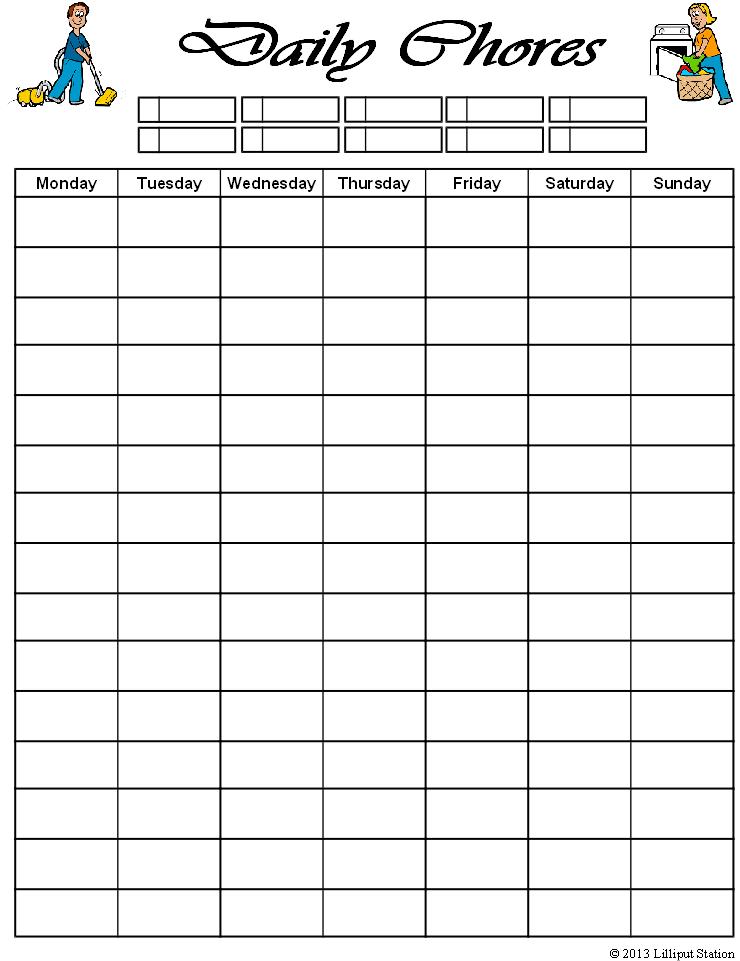
Since the chore chart I used as an illustration on my post about why kids need chores has been so popular, I thought it deserved a post of its own. My first attempts at coming up with a way for my children to keep track of their chores were a disaster. They consisted of separate lists for each child (worked for them, but hard for me if I needed to find who was responsible for a specific chore) and complicated lists with names scribbled all over them. Finally, through a lot of trial and error I came up with a simple system that used color coding. Because I had color coded everything else already (hangers, cups, etc.), my children had no trouble identifying which chores they were responsible for. And it allowed me to have different children doing the same chore on different days, without needing to clutter up the chart with a bunch of names. 


My color code, in order of age: 

  • Blue (son)
  • Red (son)
  • Yellow (daughter)
  • Green (son)
  • Orange (son)
  • Purple (daughter)
  • Pink (daughter)
  • Light Blue (son)
  • Peach (daughter)
  • Brown (all)


Some of the chores that have been on our list at different times, depending on what needed to be done and who was available to help:


  • Make Papa’s breakfast & coffee/ pack lunch (Back when I was in the midst of raising toddlers and nursing babies, my husband started paying our oldest daughter to get up early and fix his breakfast so that I could sleep in. Our 2nd oldest daughter, age 9, now does it for him. It is the only job on the chore list that earns  pay. 
  • Make bed/Straighten bedroom
  • Get dressed/do devotions
  • Help younger sibling dress
  • Exercise
  • Place bedding in the wash
  • Set table for breakfast/ clean up after
  • Make breakfast
  • AM dishes
  • Feed animals
  • Sweep & mop
  • Check garbage and compost- empty as needed
  • Clean  bathroom (wipe counters, fresh towel, etc.)
  • Clean bathroom (toilet and all)
  • Vacuum
  • Dust/wipe walls clean
  • Wash & dry laundry
  • Fold own laundry & put it away
  • Make lunch
  • Lunch clean up
  • Lunch dishes
  • Set table for supper
  • Help with supper
  • Make supper
  • PM clean up
  • PM dishes

Large Family Chore Chart {free printable}


Related Posts Plugin for WordPress, Blogger...