Pages

Showing posts with label homemaking. Show all posts

Monday, August 5, 2013

Chore Charts For Large Families

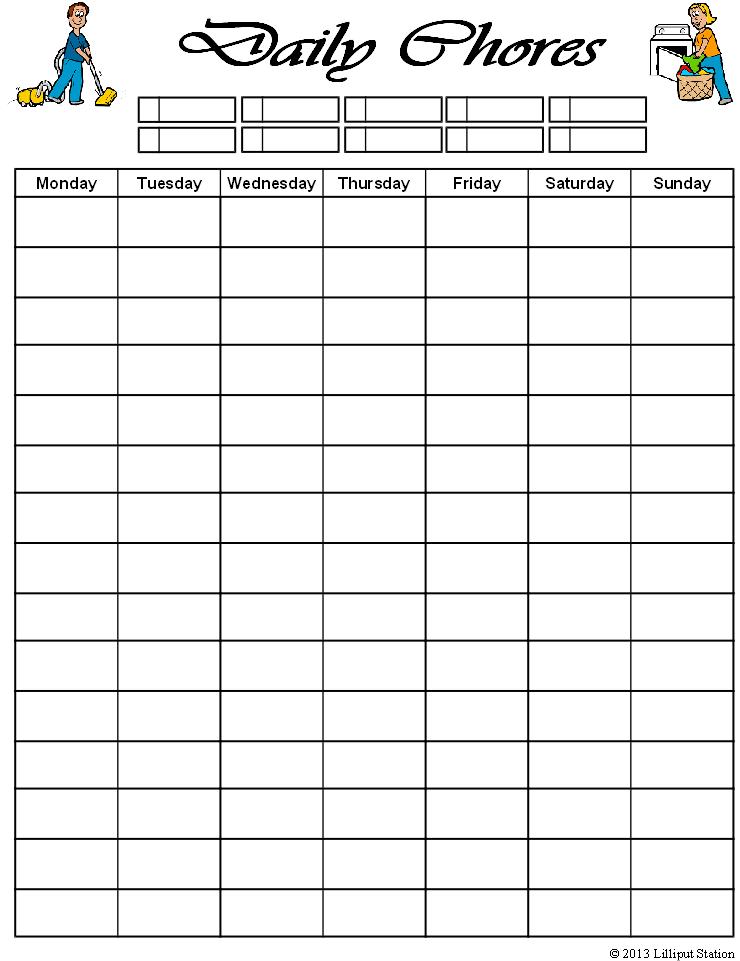
Since the chore chart I used as an illustration on my post about why kids need chores has been so popular, I thought it deserved a post of its own. My first attempts at coming up with a way for my children to keep track of their chores were a disaster. They consisted of separate lists for each child (worked for them, but hard for me if I needed to find who was responsible for a specific chore) and complicated lists with names scribbled all over them. Finally, through a lot of trial and error I came up with a simple system that used color coding. Because I had color coded everything else already (hangers, cups, etc.), my children had no trouble identifying which chores they were responsible for. And it allowed me to have different children doing the same chore on different days, without needing to clutter up the chart with a bunch of names. 


My color code, in order of age: 

  • Blue (son)
  • Red (son)
  • Yellow (daughter)
  • Green (son)
  • Orange (son)
  • Purple (daughter)
  • Pink (daughter)
  • Light Blue (son)
  • Peach (daughter)
  • Brown (all)


Some of the chores that have been on our list at different times, depending on what needed to be done and who was available to help:


  • Make Papa’s breakfast & coffee/ pack lunch (Back when I was in the midst of raising toddlers and nursing babies, my husband started paying our oldest daughter to get up early and fix his breakfast so that I could sleep in. Our 2nd oldest daughter, age 9, now does it for him. It is the only job on the chore list that earns  pay. 
  • Make bed/Straighten bedroom
  • Get dressed/do devotions
  • Help younger sibling dress
  • Exercise
  • Place bedding in the wash
  • Set table for breakfast/ clean up after
  • Make breakfast
  • AM dishes
  • Feed animals
  • Sweep & mop
  • Check garbage and compost- empty as needed
  • Clean  bathroom (wipe counters, fresh towel, etc.)
  • Clean bathroom (toilet and all)
  • Vacuum
  • Dust/wipe walls clean
  • Wash & dry laundry
  • Fold own laundry & put it away
  • Make lunch
  • Lunch clean up
  • Lunch dishes
  • Set table for supper
  • Help with supper
  • Make supper
  • PM clean up
  • PM dishes

Large Family Chore Chart {free printable}


Tuesday, July 30, 2013

Why Kids Need Chores

It saddens me to hear of young men and women who leave home without knowing the basics of how to care for themselves. Perhaps their parents thought it an act of sacrificial service to carry out the duties of home maintenance alone. Or perhaps they felt guilty requiring the child to take on any of "their" responsibilities. In some cases, they may not have even had the time (or skills) required to train their child in the duties of the home. Whatever the reason, these young people enter life seriously handicapped, simply because they never learned as children how to work.

Children need to learn how to work while they are young. They need to see a direct link between their labor and the provisions which they receive. Parents who hand everything to their children without expecting anything in return are doing their children a great disservice. They are giving them a false impression of life and setting them up for failure. These children grow up without learning the skills necessary to survive on their own. They are always expecting more, and never satisfied with what they get. Their parents, who work themselves to the bone just to provide for these ungrateful creatures, may come to resent them. But chores are more than just a way that a child can help their parents, they are vital to the child's preparation for the future.

One of the great things about having nine kids is being treated like a superhero everywhere you go. Mothers of one or two express amazement at my energy and ability to maintain my sanity. Fellow restaurant patrons stop by our table to compliment the children's good behavior, make offers to babysit, or suggest we write a book on child training. Grocery clerks ask me for nutritional advice and recipe ideas. And everyone wants to know, "How DO you do it all?"

While I'd like to maintain the "superwoman" illusion, the truth is that I don't do it all. My children contribute to the smooth operation of our household. All of them, even the littlest, have chores which they do on a daily basis. Raising nine kids is not a "one man" job. But raising one child ought not to be either. I certainly could run the household without their help, but this would not be good for me or them!


In the education of [children] today we've lost the importance of work as the most effective tutor. What is the good of knowing how to read or write if a young [person] doesn't have the heart to work, to produce, and to create? [Children] are often forced to sit for hours, year after year, in front of books. Modern child-labor laws hinder and even prevent them learning to enjoy strenuous work. Then, after twelve to sixteen years of inactivity, folks wonder why all their teenager wants to do is sit on the couch playing games."
~Bob Schultz, Created For Work

Although this book is written to young boys, I recommend it as a must read for all young folks . . . and their parents. Bob Schultz packs a lot of wisdom into every word he writes. This is solid biblical advice on how to please God in everything you do.


I sometimes get the impression that parents are waiting for their children to walk up to them and offer to help out. But in reality, kids aren't really very excited about the prospect of having to work. That's why it is important that they learn early on that doing chores is something that is expected of them, whether they like it or not.

Even a very young child can be given simple tasks to help around the house. A toddler can be shown how to throw their own diapers in the garbage or take their dirty laundry to the laundry hamper. They can help mother put the silverware in the drawer, or take the dry clothes out of the dryer. At first, this may require more work than simply doing it yourself, but by training your children to do these simple chores, and by training them to do them properly, you will save yourself much time in the end. More importantly, you will be equipping your children to live successfully in the real world.


* Above is a chore chart we have used in the past, color coded according to child. (Follow the link for a free blank printable  version of this chart.)

If you want your children to learn how to work, the best way is to show them. Working alongside your children allows you to show them how a job ought to be properly completed. It is a great opportunity for bonding and can actually be a lot of fun for everyone involved. Don't despair that you didn't start soon enough. It is never too late for a child to learn how to work.


And whatsoever ye do, do it heartily, as to the Lord, and not unto men; Knowing that of the Lord ye shall receive the reward of the inheritance: for ye serve the Lord Christ. ~Colossians 3:23-24


Before learning how to fold laundry (as seen above), this little girl helped load the dryer.


Examples of Chore Lists
Although chores will vary from family to family, it sometimes helps to see what others have done.

Chore charts For Large Families {free printable}
Chore List  
Chore Chart For Multiple Children
An organized classy chore chart is headed your way. Can you even imagine what this chore chart for multiple children is made out of??? Yep, 2x4's.
Toddler Chores
age-appropriate toddler chores

* This post contains affiliate links.

Saturday, November 10, 2012

Save Time In the Kitchen, The Easy Way


It seems like everywhere I look lately, I see directions for make-ahead crockpot cooking and meals for the freezer. These directions come with the promise that they only take "one afternoon" or "a couple of hours" to prep. But seriously, what homeschooling mother has an entire afternoon to set aside for meal preparation? How often can we even find a couple of extra hours in our schedule?

Actually, if I could prep several weeks worth of meals in one afternoon, I might be tempted to try it. But with a family the size of my family, those massive amounts of food you see artistically displayed in stacks of filled freezer bags don't last nearly long enough to make it worth it.

So, I don't follow any handy-dandy freezer cooking plans. And yet, I still manage to prepare from scratch meals, seven nights a week, without stressing. I even have a couple of meals ready in the freezer at any given time. How do I do it?!

No, I'm not superwoman. (Really, ask my kids.) But over the years I've discovered that taking a few extra minutes here and there eventually adds up to hours saved. None of these tips are very revolutionary. Most will probably seem elementary to experienced homemakers. But since they came to me in "duh!" moments after years of cooking for my family, I hope I can shorten the learning curve for someone by posting them here.

3 Tips For Saving Time In the Kitchen

1. Prep Once, Clean Once
It takes less time to make twice as much of anything as it does to prepare, cook, and clean up on two separate occasions. While you may not have the time or resources to double a complete recipe, you can still save time by doubling parts of the recipe each time you cook.
When you are browning ground meat, it only takes a little extra effort to throw an extra pound or two into the pan. Drain, cool, place in freezer bags- you've just saved yourself both cooking and cleaning time. If you are making a meatloaf, mix up enough for two and stick the second batch (uncooked) in a freezer bag. Add some vegetables on the side and you now have a freezer meal to use on a busy day. The same is true when making meatballs, though they will involve more time to prep and should be cooked before freezing. If you are cooking chicken, cook twice as much. Next time you need to add precooked meat to a recipe, you will be prepared.
When chopping vegetables, chop a little bit extra (or a lot depending on how much time you have) and toss in a freezer bag. There is nothing to say that you must fill the bag all at one time. Celery, carrots, green peppers, and onions are especially good candidates for this technique. It is soooo convienient to have some of these kitchen staples already chopped when you are in a rush and need to throw a meal together quickly. Just take out the amount you need and throw it into the recipe.
And on those days when you do have enough time, go ahead and double a whole meal. Place it in the freezer (cooked or uncooked depending on the recipe) and you not only have your first "freezer meal", but you also have a convience food you know your family will love.

2. Let Your "Servants" Cook For You
 I once sat under the teaching of a wise woman who explained that, though modern women may not have "maidservants" like the Proverbs 31 woman, we do have appliances that we ought to be using to their full advantage.
Crockpots are great for creating meals out of a few ingredients hastily added to them in the morning, but they are also a useful tool for precooking ingredients for multiple future meals. Dried legumes take hours to cook from scratch. It is much easier to open a can of beans than it is to stand over the stove stirring a pot while they cook. However, I don't do either of those things because my servant cooks them for me. I just pour a bag of dried beans, lentils, or chickpeas into my crockpot, fill it with water, and leave it cooking on high until the beans are soft. Then I rinse them with cold water and bag them in quart size freezer bags. It only takes me about 10 minutes of my time to prepare 4 to 6 quarts of cooked legumes.
An outdoor grill can be a wonderful help "in" the kitchen by reducing the number of greasy dishes that need to be washed. In addition to meats, you can grill foil wrapped veggies for a complete "mess-less" meal. Grilled chicken breasts freeze well and are a handy convienience food to have on hand. (If you'd prefer to grill "as needed", at least mix up an extra batch of marinade and  pour it into a zipper bag along with some meat for next time. Store in the freezer and thaw the night before you wish to use it.) 
The oven is often under-used when it comes to cooking helpers. Many foods that are prepared on the stove top can also be baked in the oven, saving energy and reducing messes. For instance, bacon can be spread on cookie sheets and baked at 350 degrees. (Egg casseroles like Chili Cheese Egg Puff are some of my favorite Sunday morning meals because, unlike fried or scrambled eggs,  I can take care of other things while they are cooking.)
My rice cooker is another "servant" whose help I rely heavily on. Just pour in the rice, add twice as much water, place the lid on it, push the button, and you're done! Other kitchen helpers include blenders, hand mixers, and food choppers.
3. Clean Up As You Go
I know this doesn't seem like much of a time saver, but anyone who has ever tried to scrub pans which have been left to sit overnight will know the truth of this saying. Food which splatters out of the pan will burn onto your stovetop if it is not wiped up immediately. And it takes more time to work around a stack of dirty dishes than to work in a clean, organized kitchen.
If you are doing a lot of cooking at one time, keep a dishpan filled with warm soapy water so you can do a quick wash up of utensils and mixing bowls as you finish using them. It seems so much easier when you only have a few dishes to wash at a time, rather than having to face a mountain of them all at once. And by the time you finish cooking, you might be too tired to take care of them anyway.
By following these three time saving tips, you will accumulate hours of "free" kitchen time. Without taking an entire day to prep freezer meals, you will have on hand some quick-fix meals and home made convienience foods for days when you have no time to spend cooking. And you'll still have your sanity.

What are your tips for saving time in the kitchen?

Tuesday, May 1, 2012

Three More Ways To Save Money on the Grocery Bill


People often wonder how we can afford to feed nine children. The short answer is that we can't. Sometimes we don't know how we are going to make it. Sometimes we go weeks without a trip to the grocery store, living on what can be found in the pantry and freezer. These are the times that I fall back on my Dutch heritage, using the skills bred by generations of frugal living to create masterpieces of culinary genius. (I call it "pulling a rabbit out of my hat" and believe it is the closest mankind can come to imitating God's act of creation ex nilo.) Sometimes, the creativity reaches its limits and we eat strange and not so great meals. But God has always provided and we have never gone hungry. Here are three more ways you can make the grocery budget go farther.

  1. Learn To Eat What God Provides.  It is much easier to stick to a grocery budget if you teach your children (and yourself)  to not be picky eaters and learn to eat a wide variety of foods. Grocery stores often run specials on surpluses or foods nearing their expiration dates. Gardening friends will  sometimes offer extra produce when they have more than they can handle. (You know the joke about leaving your car locked during zucchini season?) Friends with chickens may gift you with farm fresh eggs. (I admit, this is my area of weakness. I much prefer the less healthy store bought ones.) Occasionally there are  leftovers from potlucks that no one else wants to take home. These gifts are not always what we would purchase had the choice been ours, but they are still a blessing which we are happy to receive. If you are not confined to the whims of picky eaters, you will have so many more opportunities to save money on the grocery bill! However, there are times when the cost of food needs to be measured in more than just dollars. Health should always be a consideration when you are choosing what to feed your family. Even though junk food sometimes appears cheaper, you will pay an additional cost for it in the long run through poor health and doctors bills. Sometimes, being frugal isn't really very frugal at all.
  2. Eat whole foods and cook from scratch.  While real food options don't usually go on sale or come with coupons, they are often a better value pound for pound and will do a much better job of satisfying appetites. Real foods don't come "ready made" so you are only paying for food, not convenience. And cooking from scratch gives you much more control over what is in your food, so you can make better nutritional choices. However, the recent popularity of organic foods has caused the cost of whole foods to climb. For those hoping to stretch the grocery budget, the best alternative is often to take a do it yourself approach.
  3. Raise Your Own. No matter who you are or where you live, there is always something you can do to grow your own food. Those blessed to live in the country will find it easy to keep a few chickens or plant a large garden. But the idea of raising your own groceries should not seem impossible even to those living in urban areas.  I grew up in the middle of the city, but my mom still had a garden every year. It meant the sacrifice of a good portion of our yard, but it was worth it. If a garden is not a possibility for you, try growing vegetables in containers or herbs and greens on a window sill. Houseplants are pretty and help to clean the air, but why not make them edible as well? At the very least, you can purchase some seeds (alfalfa, beans, etc.) and grow your own sprouts.
Though grocery prices continue to climb, it is still possible to stretch the budget with a little creativity and some good old fashioned elbow grease. The important thing is to remain balanced. Do what you can, but keep in mind that there are other factors to consider besides the dollar sign. Don't sacrifice your health for the sake of a good deal, and don't be afraid to choose convenience when you need to. Your time is worth something too.

Part One: Use What You Have

Thursday, March 22, 2012

Use What You Have


This is the first part of what (I hope) will be a series sharing how I, as a mother of nine living in a one-income family, keep bellies full when the wallet is empty. If you have blogged on this topic, please leave a comment with a link to your post. 

Theoretically, I make a 2 week menu and go shopping every other week. In reality, the nature of my self-employed husband's occupation doesn't always allow for that. Sometimes he has unexpected gaps between jobs due to schedules being rearranged (he is a trim carpenter and can't trim until other phases of construction have been completed) or he hasn't gotten paid because the job isn't completed. In fact, there are often times when I need to stretch "two weeks" worth of groceries into three or four weeks. Once we even went six weeks without money for groceries. What does a mother of nine do when she has hungry mouths to feed, and "nothing" in the house to feed them?

The best way to make grocery money go farther is to not spend any of it. It is truly amazing how many meals I have been able to make when I have "nothing in the house" by using what was found in the cupboards, fridge, and freezer. This take a little bit of skill in knowing what types of foods taste good together and creativity in coming up with a substitute for a missing ingredient. But it really isn't that hard once you've had a little practice. I like to make a game of it, and sometimes I am (slightly) disappointed when the paycheck comes before I completely run out of food.

If you are used to being able to buy groceries whenever you need to, you might find it easy to over look the obvious when considering what you have on hand. For instance, I spent years throwing away perfectly good broth created by roasting chicken. Now I never take any of those cooking 'by products" for granted. Much of the time I will cook meats before adding sauces and seasonings so I can save the broth for other recipes. This broth is put into a container so the fat can harden and be skimmed off. Often I will use this grease for cooking purposes. (Hamburger grease from high quality beef is much healthier for frying eggs than chemical laden margarine.) If I de-bone meat, I save the bones for soup stock. If we have bits of leftover vegetables, I put them in a container in the freezer to make vegetable soup. I also save the water off canned vegetables for this purpose. I even save the water from canned tuna! It makes a great addition to seafood chowders.

Also, do your best to use food before it spoils. This is the greatest benefit of using what you have on hand. Not only does it keep you from spending more money, but it ensures that the money you've already spent has not been wasted.

For more budget stretching ideas, check out this article by my friend, Jimmie, on How To Skip Buying Groceries For a Week. She has done a great job of outlining a step-by-step process for creating a menu based on what's in your home. It is almost exactly the same method I use when cooking "from the pantry."

Part Two: Three More Ways To Save Money On the Grocery Bill


Saturday, October 8, 2011

Christmas Cookies Like Grandma Made


Baking cookies can be a messy and time consuming activity. By making them ahead of time and stashing them in the freezer, you will avoid the stress of trying to fit "one more thing" into those hectic days right before Christmas and you will have more time to enjoy creating delicious tasting and visually appealing treats.

While it is OK to add one or two of your everyday favorites to your Christmas cookie plates, they should not be allowed to dominate. Remember these are CHRISTMAS cookies. They are special once a year delicacies. A plate of Christmas cookies should be a work of art, colorful and varied in size and shape. A plate of six different flavors of round, flat cookies is not a plate of Christmas cookies. And while colorfully frosted sugar cookie cut-outs will do in a pinch, they also leave much to be desired.

Here are just a few of the recipes my grandma used to make each year. Now that she is gone, I bake them with my children. Most of them are pretty easy to make and all of them are approved by four generations of family members and friends. If you make all of these recipes, your cookie plates will be coveted by everyone who knows you. And that's good, because you will have a ton of extras to give away. 


What's your favorite Christmas cookie?


Thursday, August 4, 2011

3 Ways Parents Sabbotage Healthy Eating


While being picky may come naturally to some, there are many children whose mastery of picky eating is mainly due to the fine efforts of their parents. Here are three ways you may be making a picky eater at your own dinner table.

  1. Tell your children they won't like it
    A sure way to ensure your child will never try a new food is to introduce it to them with an extra large helping of doubt. And who can blame them? Would you want to try something that you have been told will probably not taste good?

    Remember, everyone has their own oppinions on what they enjoy eating. If you give them the opportunity to try something new without first prejudicing them against it, your child may enjoy many things you never dreamed possible. Otherwise, they will not only be limited by their own dislikes, but by yours as well.

  2. Hide the veggies
    I don't know how many times I have read some misguided author write about how to work more vitamins into a child diet by hiding vegtables in cookies, spaghetti, etc. While this may work miracles on a mother's guilty conscience, it won't do anything to help junior learn to eat what's good for him. Children learn to eat a variety of foods by being served a variety of foods, not by being served healthier versions of the same old junk.

  3. Offer an Alternative
    When faced with new and unfamilar foods, many children automatically assume they won't like it. If given a choice between a new casserole and peanut butter and jelly, they will naturally pick the old favorite. However, a single taste may be all it takes to introduce them to a new favorite. And since food preferences can be acquired, repeated introductions to unpopular foods can sometimes result in new favorites over time.
Related Posts Plugin for WordPress, Blogger...